Wednesday, February 28, 2007

BOMB IRAN: Updated USAF basics on counterforce strategy vs. WMDs
Bomb Iran

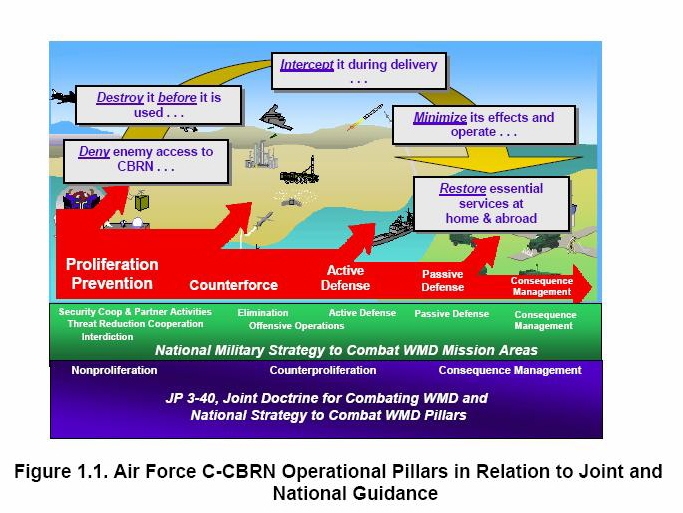
The graphic comes from Air Force Doctrine Document 2-1.8, Counter-Chemical, Biological, Radiological and Nuclear Operations. It was made available through Steve Aftergood's Secrecy Blog today and you can find it here.

Your friendly neighborhood GlobalSecurity.Org Senior Fellow believes the left half of the artist's rendition accurately represents how the USAF has planned to deal with Iran. In fact, it looks just a little bit like Iran in its desert tone with large southern body of water in which floats an Aegis missile cruiser.

Note the B-2 stealth bomber dealing with infrastructure and the cruise missile in flight.

The USAF calls this counterforce, the elimination of chemical-biological-radiological-nuclear threats through kinetic action. In this paper it is also tied to preemption. This is part of "a comprehensive approach to defeating WMDs," the Air Force writes.

"Counterforce refers to offensive operations to strike adversary CBRN weapons and associated production, transportation and storage facilities prior to use...One unique aspect of this pillar is that it may be executed by a preemptive military strike."

"As we have seen in previous conflicts preemption requires close coordination with friends and allies, as well as the American people, in order to be accepted and effective," writes the Air Force genially. "From a tactical perspective, pre-attack intelligence and precise target location are crucial."

Counterforce strategy, states the document, would also lead to a "rollback of the adversary's CBRN capabilities..."

And quoting from another's book on bombing Iraq in Desert Storm, the Air Force flashes a bit of literary flair on the smoke of battle:

". . . F-117A's proved particularly devastating, for unlike [cruise missiles], they could destroy hardened targets. Laboratory, research and production facilities staggered under stealth-dropped smart bombs; video subsequently showed blasts sending destructive ripples through buildings like some parody of waves crashing on the beach."

Waves crashing on the concrete beaches; the odor of rubble and dust in the air at dawn -- the smell of victory!

Uh, excuse me, got carried away there for a moment. To transpose from Herman Wouk in War and Remembrance: "Enemies [like Iran] should ponder it."

"Target hardness and/or collateral damage considerations may make direct attack against WMD or related facilities impossible or undesirable, but an effects-based approach to targeting may result in alternatives that prevent the adversary from gaining access to ... WMD."

Translated: So, you've dug deep holes and poured thick concrete! How good are your shovels?

"Operations against production facilities provide another option for degrading or destroying an adversary's CBRN capability," it is written. "While the effect of the operation may be temporary, strikes against production facilities represent a relatively low risk option ... especially if the enemy has not yet achieved an operational CBRN capability."

It is difficult to find any fault or argue with the logic of the air force document. It is easy for laymen to read and understand.

The only quibbles DD has with it were the inclusion of only semi-relevant box quotes attributed to George W. Bush and an info-box on the Aum Shinrikyo. With regards to the former, GWB is not going down in history as a perceptive commander-in-chief. Leave him out in the next revision, fellows. As to the latter, see here:


Having taken the liberty of correcting the graphic, no spectroscopic or hard chemical evidence has ever been presented that Aum Shinrikyo produced VX. The material is difficult to synthesize and word of it in the hands of Aum Shinrikyo is tenuous, existing only in testimony.

The group also never produced botulinum toxin and as to anthrax, it cultivated a vaccine strain of Bacillus anthracis, one that could never have produced disease. See here.

No charge for the help, gents.


Related: Operation Radiating Rubble -- the computerized wargame of preemptive USAF/USN counterforce vs. Iran, developed through use of military data sets from GlobalSecurity.Org.


Ah-ha! Armchair Generalist does find fault with the Air Force's use/misuse of old Cold War language and explains the semantic and syntactic shenanigans here.

Tuesday, February 27, 2007

JOSE PADILLA AND THE MANCHESTER MANUAL: US can't resist the moldy-oldy but a judge does the right thing

Buried inside today's Los Angeles Times was a story entitled, "Ruling on book benefits Padilla: Federal prosecutors tried to argue that his actions jibed with an Al Qaeda manual." (No link. Read it in subscriber copy, no web access because it's behind a reader hostile tribune.com registration wall.)

Reporter Carol J. Williams wrote, "A federal judge in terrorism suspect Jose Padilla's competency hearing on Monday refused to admit into evidence a purported al Qaeda manual that prosecutors said advised captured terrorists to cooperate with attorneys and to allege they were mistreated -- as Padilla had done."

"US District Judge Marcia Cooke said there was nothing to indicate Padilla had ever seen the inch-thick 'Manchester Manual' found five years ago in a raid in Manchester, England."

The judge did the right thing.

The use of the Manchester Manual by a prosecution is now a sign of grasping at straws, an indication that the offense is doing badly. During the London ricin trial of 2004-2005, British prosecutors used it as part of a collection of documents they wished to use to demonstrate a linkage between al Qaeda and an alleged poison ring. They failed because the poison recipes taken off convicted killer Kamel Bourgass were traced to translations from American sources and Yahoo servers in Palo Alto, California.

A lawyer for the defense in the ricin trial also remarked that the Manchester Manual's designation as an al Qaeda manual was an American invention, specifically the US Department of Justice's, which posted an edited form of it on its website.

Last summer, your friendly neighborhood GlobalSecurity.Org Senior Fellow wrote that informed readers know that when someone invokes a "document" attributed to have some meaning in the war on terror, it's time to review it. This is because you either won't be getting the entire picture, or its historical context and provenance will be distorted in some interesting but politically or legally expedient manner.

And so it is with the Manchester Manual which has become a talisman for failing terrorism cases. It is a totem to shake when parties wish to convince people of something about terrorism based on little hard reasoning or evidence. (One original discussion is here from when George W. Bush's speech writers wished to allow him to make a connection between al Qaeda and Hitler. The Manchester Manual, one was supposed to believe, was al Qaeda's 'Mein Kampf' and approved of torture, something us Americans would never stoop to.

The Manchester Manual does indeed speak about ill treatment at the hands of interrogators. It does not use the milder word mistreatment. It is straightforward in its use of the word TORTURE and this comes in a section at the very back of the manual dealing with what "the brother" should do if he is captured by a Middle Eastern regime known for torturing prisoners.

Torture is expected in the Manchester Manual and, curiously, there is no mention of the United States, probably because at the time the manual was written, this country didn't have a rep as torturer.

These sections are not about alleging that one has been tortured by interrogators in order to throw off authorities. They are what to do when one is expecting to be tortured and when one is tortured.

In reading the Los Angeles Times article it is difficult to know how much the reporter and other parties know of this. One wishes to give them the benefit of the doubt but it is difficult to know who is the source of misinformation in this particular piece.

In the next three graphic snapshots, DD shows the sections of the Manchester Manual which the prosecution attempted to employ to show that Padilla and his lawyers are making it all up with regards to his ill treatment.

Note: "[In our country, the police authority] does not hesitate to use all kinds of torture ... " and "Under pressure of torture ..." -- as well as, "Torture of the brother takes place once again in the questioning apparatus ... "

It does not say anything about faking being tortured.


The manual continues with a straightforward discussion of establishing a baseline by asking for medical examination whether one has yet been tortured or not. Then, when one is tortured, to ask that this be entered into proceedings.

"The brother may have to confess under the pressure of torture ..." it reads.


More of the text, above, tells the jihadi he will be beaten and tortured.

This is not a section on how to trick people into thinking you've been mistreated in court. Instead, it is a section on what to expect in an interrogation cell.


Since the United States government established itself as a torturer for the sake of winning the alleged war on terror, it is now a questionable, self-defeating and confounding tactic to imply that a document which clearly discusses being tortured in other countries -- not the United States -- is about teaching one how to allege mistreatment when one hasn't been mistreated.

On the contrary, the government's position on this item is, so to speak, tortured.

Although the judge did not appear to address these technical details, she did the right thing when tossing the document and argument out under the explanation that there was no reason to believe Padilla knew of the Manchester Manual.

Other extracts from the what-to-do-when-tortured section of the Manchester Manual -- here.

The entire Manchester Manual, duplicated at Cryptome -- here. Relevant section near end.


There is further discussion an excerpts from the New York Times' article on the manaul treatment here. By way of Discourse Net, the NYT reported:

"In declining to admit the manual into evidence, [the judge] added that the manual would have converted the competency hearing into a debate over whether the defendant had been tortured in the brig."
THE INDELIBLE STAIN OF THE LONDON RICIN CASE (Continued): Sent home for torture and jail

In a story in today's Guardian, it is revealed two men held by the British government and later deported to Algeria will tried as terrorists in that country.

It connects to the ricin trial because one of the men, known as Reda Dandani, had been implicated by Mohammed Meguerba (Mahmoud Meguerba), the police informant for the case of the London ricin ring. As was written last week, when consulting with a colleague who was an expert witness for the London ricin trial in 2004-2005, it slowly came out that Meguerba had been tortured in Algeria.

The Guardian reports: "Reda Dendani, has been implicated by Mahmoud Meguerba, an intelligence source in the ricin trial, according to information received by Amnesty International. Meguerba, who was not called as a witness because he was considered unreliable, is reported to have been tortured by the DRS, the Algerian military security police."

Meguerba's evidence never made it into the London ricin trial and the prosecution case failed when the UK government could not prove any conspiracy connected to al Qaeda. In the case of "Bourgass et al," a jury found the co-defendants of the imprisoned Kamel Bourgass not guilty.

Many suspects were swept up and detained in what became known as Operation Springbourne, the anti-terror dragnet that preceded the London ricin case. When the trial ended, English authorities slapped control orders on the exonerated and began planning to deport them to Algeria.

The control orders were the equivalent of home imprisonment. In the meantime, the government began the process of trying to convince human rights observers that deportation back to Algeria, a country that tortures, would be all right.

In this it was unsuccessful.

Nevertheless, those subject to control orders, their lives ruined even though they had been found innocent, seemed to slowly go mad.

"[They] were detained indefinitely without trial under anti-terrorist legislation and later subjected to virtual house arrest under control orders," reported the Guardian. "In August 2005 they were imprisoned under immigration rules pending deportation."

"Their lawyer, Gareth Peirce [who was the organizing defense lawyer for the ricin trial,] said they could no longer bear the strain of indefinite detention and had withdrawn their appeals against deportation orders after assurances that they would not be prosecuted."

In Algeria this means little if anything and apparently those returned will be tried as terrorists.

The men were deemed a danger by British authorities, and in methods similar to those used to remove the rights of prisoners in American detention at Guantanamo, were said to be so through secret evidence which could not be examined or refuted.

The catalyzing events for this harsh treatment were the London bombings of 2005.

"Before the London Underground bombings in July 2005, the government accepted that Algeria's human rights record meant that sending suspects back there would breach the European convention on human rights, which bans inhuman or degrading treatment or torture," reports the Guardian.

"But in August 2005 the Home Office started moves to deport 15 Algerians deemed, on the basis of secret intelligence unusable as evidence in British courts, to be a danger to national security."

After the ricin trial, the defendants were retried in much of the English media where anti-terrorist expert and prosecution claims and opinions rejected by the jury were given a fresh airing. British lawmen rehashed the material from Mohammed Meguerba's confession, information which had not been allowed in the case.

The men released would have to be watched, it was claimed. At the time, there was one heartening development -- the alarm of the jurors who did not remain silent.

"We as a jury made a decision," they said. "To see the government disregarding our verdict and preparing to send [the cleared men] back to almost certain torture is horrifying. We would try to do anything to stop it." ("Freedom's Bright Lamp," The Guardian, May 21, 2005)

And they have continued to try as have others, without effect, through no fault of their own. It has become apparent fighting city hall is really tough in the so-called war on terror.

The Guardian piece is here.

24, torture, the ricin ring and reasons for war with Iraq is here.

National Security Notes at GlobalSecurity.Org on early repercussions from the ricin case in 2005 -- here and here.

Monday, February 26, 2007

SELF-FORMING FRAGMENT MUNITIONS: Explosively formed projectile, what's the difference?

The Danger Room blog expertly shows the ubiquity of EFP munitions here and here. The message in it is that one someone in the government or US military says a national fingerprint is found in some weapon, implicating some culprit we love to hate, your eyes should roll.

Last week on the Military channel's Futureweapons, a weekly show in which a shaven-headed ex-Navy SEAL gets multiple erections over assortments of bombs, guns and weapons platforms, your friendly neighborhood GlobalSecurity.Org Senior Fellow spotted a segment on EFP's developed by Alford Technologies of England. Alford's EFP is called the Krakatoa and it was peddled as a modern equivalent of the Limpet mine for special forces.

Futureweapons has been free advertising for Alford with the company's chief scientist as nutty professor showing off his special bombs in the backyard. For this episode he slapped together a copy of the Krakatoa for the ten minute segment. Not so hot for the show, DD didn't hear the word "EFP" once, something that revealed the segment was made long before the military's recent dog and pony show for reporters made the acronym common usage.

Alford's website is here.

DD thought the term used to be "self-forming fragment" shaped charge and, indeed, one can find the name across the web in pieces on Russian bloc anti-tank mines in Serbia and even in this old book, "Explosive Loading of Engineering Structures," here.

Reactive, or Chobham, armor is the old countermeasure for such charges, the text seems to indicate.

Futureweapons, as usual, is entertaining for all the wrong reasons.

Its writers are insane.

For a segment on a new recoilless machine gun that shoots "smart" grenades, the host beamishly goes on that previous to the invention of this miracle, US forces would have no recourse but to riddle a building with heavy fire. Now, with the new "smart grenade"-shooting machine gun, one can pump shells through the front window into the living room. The grenade waits until it's inside, then blows up, showering the interior with splinters, allegedly minimizing collateral damage so that people can move right back in.

That is, after they've picked the blood, flesh and bone out of the walls and removed and refinished the interior.
IF AT FIRST YOU DON'T SUCCEED: Rocket attack


DD whiffs a straight up the stern attack with an undershoot in Lock On: Modern Air Combat! Of course, once again the screen shot of the second pass, the one with the line of fire stitched right across the beam, was unsuitable. [Eyes roll.]

Sunday, February 25, 2007

EAST OF THE KERCH PENINSULA: Sunday afternoon dive-bombing in Lock On


A Russian corvette barely survives a near miss from a 500 lb. bomb in the narrow waterway east of the Kerch Peninsula. (Note pom-pom gunfire from out of frame ship leading the surface action group.)

It's another squandered Saturday and Sunday in DD's dogged effort not to let the Lock On: Modern Air Combat monster game get the best of him. The tanker the frigate was escorting was an easier target and not so lucky. Unfortunately, I wasn't fast enough to get a screen shot while trying to evade deck gun fire so you'll have to take my word for it.

As a continuing installment from last weekend's riff on monstrously complex war games and Lock On, this small success didn't come without thorough preparation.

Lock On, like any respectable monster game, substitutes procedure and complexity for realism. If you want to get much out of it during its acclimatization period, one must come to grips with the mission editor, if only because the missions furnished for you by the game's developers will familiarize one only with crashing and bewildering environments.

The mission editor offers a way around this because, theoretically, it allows the beginner to write his own script. Lock On pitilessly disabuses you of the notion you'll succeed in a total fog-of-war environment, flying with a bare paragraph or two of instructions on the nature and general direction of the enemy. In other words, when you're learning just how to do a level weapons run without porpoising through the air in a badly flown aircraft, black box missions designed by other gamers don't work.

Saturday, then, was spent prepping the battle.

DD has no idea why Lock On is set between the Crimea and oil rich-Terek River/Caucasus Mountains regions in Russia. It has something to do with the Ukraine and Georgia as republics a coalition of NATO forces has chosen to defend from Russia, a rather hysterical proposition. The Netherlands, Germany and Turkey will enter into a significant "coalition" with the United States? ORLY?

In any case, that's the scene.

And for my battle, I had a small Russian naval group escorting an oil tanker through the narrow waterway connecting the Sea of Azov and the Black Sea. You can't lose anything in such a small area, making finding targets easy. That was on purpose.

Still one must plan carefully and schedule a coordinated strike in which different planes and weapons packages arrive over the target area in such a way as to peel back its defense so that your flight of A-10's can arrive over the primary objective, in this case the tanker and its smaller escorts, with some reasonable expectation of being able to sink or cripple them by dive-bombing.

There is also really no such thing as a fire-and-forget or "smart" weapon in Lock On. Therefore, one can count on a steady percentage of misses and inefficiency on the part of an entire strike force, something that would be unpleasant for the standard gamer just wishing to jump in and play.

While building the mission, one must test it while under construction to evaluate for bugs, stupidity and balance. It is easy to bite off more than one can chew. Setting conditions for a little fun Santa Barbara-like mid-day fog over the water, quite naturally if unexpectedly, made it impossible to conduct visual bombing runs. Thick mist! Can't see!

And as a simulation you're trying to use for some afternoon entertainment value, it does no good for a strike force to be so front-loaded that everything is blasted by the computer AI battling itself before your slower A-10 arrives, or for the air cover to be so stout that the entire mission is spent just trying to survive and disengage. That is, unless you enjoy the idea of playing someone like the Japanese in the Marianas Turkey Shoot.

If you've practiced, set things up properly and been meticulous in planning, you can be rewarded with a scene like the above snapshot. It's success of a sort.

Lock On, it should be mentioned, offers six flyable combat aircraft. Two American, of which the A-10 is one, and four Russian. Each requires a different session of variables and procedures to be memorized. DD has already decided that understanding two out of the half-dozen is doing good.

Friday, February 23, 2007

BIG FRIDAY TORTURE POOL: Wallow in it

Happily coinciding with DD's torture and 24 column over at el Reg was HBO's Ghosts of Abu Ghraib. It was well-reviewed just about everywhere by various TV critics. One example is here at the Indianapolis Star.

I watched Ghosts last night and while it was everything previews promised, it was turned off about two-thirds through. By this time I've seen more than enough of the Janis Karpinski speaking tour. The ex-dean at Abu Ghraib Torture U, Karpinski has flogged it, according to the Internet movie database, appearing on comedy talk shows and radio (The Daily Show, Bill Maher, and the Al Franken show), in addition to Iraq documentaries.

Please, no more Janis, no more Megan Ambuhl, no more Sabrina Harman, the latter so brainless and morally dead she hadn't the common sense to know playing smile for the camera over a man who has just been beaten to death constituted a couple of atrocities.

Pretty much absent are any people who had the guts to say "I won't do it, I'm going to blow the lid on this and if you try anything you'll have to torture or kill me, too."

Take them to the glue factory and put 'em all down to prevent even more book contracts and movies for being pieces of excrement. No more of slippery John Yoo explaining that the newfangled war on terror meant it had to be OK to suspend the rights of anyone captured unless someone gets to smack the man in the teeth with a baseball bat after he says it.

Once again it reminded me of the London ricin trial. During long telephone conversations across the world, as evidence was reviewed, I recall asking my colleague where all the allegedly scary hearsay on the defendants being part of a Wood Green poison factory allied to al Qaeda was coming from. Mohammed Meguerba, was the answer, a police informant who had been tortured in Algeria and who later recanted it. Of course, Meguerba never testified at the trial and when it came time to tell the US newsmedia, no one wanted to hear any of it. And we tried, coming to the conclusion that it would have to be published at GlobalSecurity.Org before anyone else went to press. When the paltry few in the US newsmedia did get to publishing, it simply repeated the bad information from Meguerba.

Looking back through this blog's archives, a couple more pieces on torture:

The tortured debate on torture.

Ugly details from a Senate report.
TORTURE! Better Jack Bauer than George W. Bush's goons

Today, at el Reg, DD discusses his experience with the fruits of torture with recent mass media protests over "24's" love of the same.

DD has no trouble with "24." "24" is silly and so is Jack Bauer. Back in December, I clapped my hands when Star Trek: Deep Space 9's Dr. Bashir showed up as a villain.

Cancelled doctors must know how to torture and Bashir did not disappoint. He tortured a former comrade really great, cracking him for the information in seconds. Then he killed the guy.

Jack Bauer, who had eased up on torturing the same man, said to Dr. Bashir that he didn't know if he could do such deeds well anymore. And Dr. Bashir looked at Jack, smiled a little and said, "It'll come back to you."

Anyway, "24" plods along week to week, a soap opera of terror porn, easy to follow, not even remotely real, easier to digest than current events. It's a lot easier to watch than Ghosts of Abu Ghraib or Iraq for Sale, any documentary starring John Yoo, Janis Karpinski and miscellaneous pieces of white trash from the country's jobless underbelly explaining how and why they did what they did.

And that is, I reckon, why many like "24," not so much because watchers think Jack Bauer is the real thing in the war on terror and we should have more like him, but because we can't bear to know the real thing.

Read it here.

Thursday, February 22, 2007

PRACTICAL MATTERS VIS-A-VIS CHLORINE: Hard to use but scary

Your friendly neighborhood GlobalSecurity.Org Senior Fellow is an expert with regards to chlorine cylinder handling. This knowledge is convenient while reading of recent insurgent attacks in Iraq using industrial cylinders of the halogen bundled with explosives. (Read this and learn, American troops! It is a better briefing than any you will get in country.)

During summers off from undergraduate work at Albright College in Pennsylvania, DD managed the Pine Grove Community Swimming Pool, a half-a-million gallon volume sanitized by chlorine from industrial cylinders.

Adequate chlorination required the exchange of cylinders every 10 days.

Cylinders would be manhandled from storage, the new ones exchanged for the exhausted. Connection was made to a gas regulator and bubbler which released the element into the water spillway connecting the pool's pump house and the main inlet into its concrete basin. Damaging or shattering the valve at the top of the cylinder was not a significant problem. Even if wide open, it did not release the element in sufficient density or velocity to create a danger to many.

Chlorine cylinders were delivered by the industrial chemical supplier, Manley-Regan, of Middletown, PA. They were ferried around Schuylkill County to swimming pools, chained to the sides of flatbed trucks. The cylinders were very robust. They had to withstand falling off trucks and collisions. As a consequence, their handlers were laissez-faire, infrequently tossing the cylinders off the back of the loader onto the asphalt of parking lots.

The chlorine cylinders dug up the asphalt in the lot at the Pine Grove pool and I complained. So the distributor drove the truck onto the grass nearer the swimming pool, tossed them off the back, where they only dug divets in the lawn. Thanks! It was important to keep your feet out of the way.

Anyway, the lesson here is that it takes a bit of effort to blast open a standard chlorine cylinder, enough effort to make the actual explosive needed to burst the tank more of a danger than the actual amount of halogen contained within it.

Still, one can't turn up one's nose at chlorine.

Chlorine is immediately sensed in the corners of the eyes and by the Mark I nose. It is extremely active, as any halogen is, and burns sensitive tissues, but not skin, immediately. Because of this it is not a particularly effective poison gas.

People who get a whiff of chlorine perceive it well before immediately lethal concentrations arrive and move quickly away, if they can. Bursts and puffs of chlorine cause halogen irritation to the mucous membranes and conjunctiva of the eyes fairly rapidly, something workers at the community swimming pool under my watch learned through experience.

So, as a practical matter, use of chlorine gas as a weapon is contingent upon quick delivery of extremely large volumes.

In Robert Harris and Jeremy Paxman's A Higher Form of Killing, an older book on chemical warfare, chlorine's use by Germany om the western front in 1915 is detailed.

"German pioneers [opened] the valves of 6,000 cylinders spread out along a four mile front," the authors write. "The breeze stirred again, and 160 tons [of chlorine], five feet high and hugging the ground began to roll toward the Allied trenches. Chemical warfare had begun."

One immediately sees the insurgents in Iraq aren't close to achieving the chlorine densities used in full-on chemical warfare. Indeed, the great amounts needed to wage such a war quickly had WWI combatants looking for different, more deadly, poison gases. Chlorine was bad but things could be made much worse and they were.

The issues are handled with aplomb over at the new Danger Room blog and at el Reg, both noting the impact is still mainly psychological.

Dick Destiny defecated upon a lobbying company built from refugees from the Department of Homeland Security and their lack of knowledge on various chemical weapons, including chlorine, last year -- here. And if you go here you'll read about another alleged government expert telling a crowd of rubes they can make a terror weapon out of it by using bleach. Back in the day we had a word for such people and that word was: Idiot. (Search page for "Sidell.")

Additional information is furnished here on alleged homeland security guru, Richard Falkenrath, who became possessed in a mission to protect America from the dangerous release of gases like chlorine. Read the fine print and you'll spy mention of mass releases of chlorine from rail cars in Graniteville, South Carolina, and Macdona, Texas, resulting in nine and three dead, respectively.
CRACKPOT DHIREN BAROT: Redacted evidence provides riches of embarrassment

In the war on terror one can reliably count on authorities and experts to exaggerate the powers and savvy of al Qaeda terrorists. Having dealt with it at length, it's accurate to say that such claims are often dependent on the public not getting a close look, or an accurate interpretation, of gathered evidence. And even when the evidence is produced for examination, the mainstream media will not look at it, prefering to rely on its interpretation by lawmen or experts who'd lose their livelihoods if they became known for conservative views on the subject.

The evidence gathered from crackpot dirty bomber Dhiren Barot, presented as an extensive list of files on the website of the London Metropolitan Police under the heading of Operation Rhyme, provides an opportunity for a close look.

Before we travel out to that locale, however, it is worthwhile anchoring it by showing how experts use cases like Barot's to make points on how enemies are preparing to bite us again. (Here's a fairly representative piece on the mythology of Barot at CBS News. The reader will notice it relies entirely on he said/she said reporting, not on any actual examination of Barot's jihadi files.)

In this case, now have a gander at terror expert Bruce Hoffman's op-ed for the Los Angeles Times, Remember al Qaeda? They're Baaack.

With it's infantilized title taken from the old horror movie, Poltergeist II, one conjurs images of al Qaeda staking out your living room, preparing to kidnap your kid and move the furniture around. Drubbed by critics as "elaborately pointless" and a "rehash of the first movie's story," it sort of fits many discussions in which al Qaeda is said to be coming. The writers of Op-Ed's don't assign the titles to their pieces, editors do, and this is just about the worst choice imaginable.

"...the truth is that the organization is not on the run but on the march," Hoffman writes.

Maybe it's true, maybe it's not. Toss a coin, heads they are, tails they ain't, and you might have as good a divining.

Hoffman appears to drag in Dhiren Barot, not by name, as part of reading of the tea leaves by looking at al Qaeda plots.

"Ongoing investigations increasingly suggest that recent terrorist threats and attacks — the foiled 2004 plan to stage simultaneous suicide attacks in the United States ... " reads the article.

If one scans the rap sheet on Barot at GlobalSecurity.Org here one immediately sees the charges on plotting to blow up US financial institutions. One also reads a US terror alert was prompted, and "...later criticized because it was several years after [Barot's] casing had taken place." Barot's videos of his NYC scouting trip are also available on the Operation Rhyme site.

In Britain, Barot is more well known for the evidence taken from files on his computer. These are compilations of public texts taken from the Internet, cut and pasted together in attempts to pitch to al Qaeda higher-ups a ludicrous dirty bomb plot employing smoke detectors and another half-baked scheme to pack limousines with gas cylinders in the hopes that they could be driven into a parking garage and detonated. In no case had Barot accumulated any actual materials. These were virtual plots and in his files the al Qaeda man reveals he hasn't even been able to secure a hand grenade.

The London Metropolitan Police posted Barot's files in its display for Operation Rhyme here.

Your friendly neighborhood GlobalSecurity.Org Senior Fellow will be primarily dealing with the dirty bomb and gas cylinders/limousine files, the latter also containing a focus on Barot's yen for a radiological weapon. (These presentations are entitled terror65-04mas11, terror65-04mas12 and terror65-04gaslimos.)

Examination of them isn't something newspapers, or for that matter brief TV news shows, like to do. To understand why these documents are ludicrous, one has to show them and then perform some cross-referencing to materials from which they were derived. It's graphically intensive but, by nature, dry and dusty. It's simply not as exciting as blurting out that al Qaeda's on the march and we nabbed Dhiren Barot just in time.

If you download these files you'll see they're heavily redacted. In fact, most of the content in them is blacked out, mindlessly so, as will be demonstrated.

"Some information has been concealed," reads the website, understating it a bit. This was because the files "[contain] information regarding security measures, positions of cameras, smoke detectors, etc and other information potentially of use to those who would wish to exploit them."

In other words, one is asked to believe that a dirty bomb can be made from thousands of smoke detectors.

However, making a dirty bomb from a lorry full of the household items wasn't Barot's only wish. He also fiddled with other really stupid ideas.

One involved used exit signs as a weapon of terror. In the United States, exit signs containing a very small amount of tritium, a radioisotope of hydrogen, have been smashed in buildings and thrown into landfills for years. It's thought to be a slight hazard but no one really cares about the issue as the danger is negligible. The EPA posts a fact sheet here.

One of Dhiren Barot's dirty bomb plots proposed the throwing of exist signs into the middle of rooms.

Barot also dallied with getting tritium for a dirty bomb from wristwatches.

"Two types of radioactive materials I did not investigate are Uranium and Plutonium," Barot writes. "Not available off the shelf I decided to leave these radioactive materials out of this research."

Throughout his files, Barot returns to the idea that his terror weapons should be made from off the shelf items, and that -- Allah willing, inshallah -- his plans will come true. In this quest, he cast around aimlessly on the Internet, cobbling together files on radiological hazards from common public sources. It is work on the lines of what a high school student might be able to accomplish over a weekend.

Barot is, in other words, dumb as dirt. His files reveal him to be a wishful man with no capacity for critical thinking and absolutely no acumen in science or demolitions. If he is an example of al Qaeda tutoring, it is difficult to come to the conclusion from fairly judging him that such training was worth anything.

" . . . home smoke detectors would not pose a security risk but smoke detector factories could," writes Barot, in one his files. At this point, he apparently starts to develop his plan for a dirty bomb made from lots and lots and lots of smoke detectors.

Smoke detectors contain a vanishingly small amount of americium-241, a man-made radioactive element indicated as radioactive ammunition for potential dirty bombs.

However, a smoke detector contains only about 1 millionth of a Curie of the element.

That figure is a merciless barrier with regards to terror planning, one Barot ignored because he is a stupid man. He would have had to buy ten million smoke detectors. That's ten, followed by six zeros, to make the small dirty bomb payload envisioned in dirty bomb analyses furnished by physicists.

Next up, here are the excerpts from Barot's journal files. These segments are not redacted, probably because they were necessary to make the case against him.


Note the "inshallah" invocation. God willing, we will make smoke detectors into a dirty bomb.

However, another interesting feature of Barot's files is their use of common articles which most scientists and reasonably educated people wouldn't bat an eye at. They contain no information that is immediately helpful to dirty-bombing terrorists. Instead, they are forthright discussions on various aspects of radiological hazard, necessary to public understanding of the subject.

These portions are all heavily redacted. However, since DD is familiar with the literature, moreso than the Brit anti-terror men who did the redacting, some of the blacked-out parts will be reconstructed for purposes of this discussion.

A great deal of Barot's presentations are taken from a Monterey Institute publication, Commercial Radioactive Sources: Surveying the Security Risks, by Charles Ferguson, Tahseen Kazi and Judith Perera. It is here.

In Barot's files, we see the Brits have blacked out the following flow chart. Could it be a very dangerous terror plan?


Nothing of the sort! It's Barot's almost exact copy of an illustration from the Monterey paper. Mindless!


If that was not sufficiently perplexing, here is another meaninglessly redacted excerpt from Barot.


In this instance, the police have blacked-out the figures from a publicly available table on the health effects of ionizing radiation. For his journals, Barot put it in upside down. Here is the original.


It comes from Dr. Rosalie Bertell's, "No Immediate Danger, Prognosis for a Radioactive Earth" and it's here.

And for a more sufficiently absurd redaction, please to look at the following.


Here, the Metropolitan Police redact the name of physicist Steven E. Koonin and a brief discussion by him, published in the letters section of the journal of the American Physical Society in 2002. It's here.

DD could go on but believes the reader gets the picture. The dissection of Barot's journals show that the man, while deserving of jail for his scheming and wishful thinking, was not the type of person who can easily be used to make the case that al Qaeda is on the march. If their marchers are all like him, one might be moved to come up with a different assessment of the terrorist organization's powers.

Is al Qaeda on the march? DD doesn't know. He knows Dhiren Barot was a malicious crackpot with busy and ridiculous plans. Barot was not a breathe-a-sigh-of-relief victory in the war on terror but, more accurately, a piece of detritus rightly swept off the street.

However, this discussion shows once again that public perceptions about terrorism rely on their symbolic interpretation by mass media and experts.

In this particular case, it's still a mystery why so much of Barot's files were ridiculously blacked-out by British counter-terror men. Could it be because the true nature of them is somewhat less than fear-inspiring? Possibly. But one supposes bureaucratic ignorance, the embracing of the abundance-of-caution mantra and stupidity are as good an explanation as any.


If you enjoyed this analysis, you'll find -- Dhiren Barot and the Will of Allah -- equally fascinating.

Tuesday, February 20, 2007

HEARTS AND MINDS: Great slogan for when things have tanked all over

Reading today's newspaper, DD spied one of the news stories from the Iraq front on winning "hearts and minds." They're always identical. Slot the pic of the Marine or the Army soldier, his hand outstretched to an Iraqi tyke in the rundown battle-scarred street. Look, there's the pic of the officer having to do a social dance with the local tribesmen.

One believes the soldiers are absolutely sincere in it. The thought also occurs that implementing the chocolates-and-nylons thing when large swaths of Baghdad are ghost towns, as the mainstream news puts it, is like trying to empty the war's ocean of hatreds, sorrows and pain, one thimbleful at a time.

"Hearts-and-minds" is just a slogan, utterly brain-dead, now good for any use or argument from the left and right.

Recent applications in varieties of groupthink, frequently ridiculous:


Brutal Reality of Battle for Hearts and Minds Sniper fire, ambushes, unseen enemies ... the US fight to win the trust of ordinary Iraqis is taking place in dirty alleys and ruined police stations. --The Guardian

"...to consistently protect the population from insurgent reprisals, thus winning the minds part of the hearts-and-minds struggle..." -- Wall Street Journal

Brits to spend lots of money to jolly-up Muslim community alienated by counter-terror lawmen during the past few years

"£5m 'hearts and minds' fund to fight Muslim extremism
"Communities Secretary Ruth Kelly said the 'battle for hearts and minds' cannot be won from Whitehall as she set out fresh guidance on the role town halls ..." -- Guardian

"A regime change occupation force achieves victory by winning the hearts and minds of the occupied people by dramatically improving living conditions improving living conditions, infrastructure and the economy. During the almost four-year U.S. occupation of Iraq, we have not come even close to accomplishing those objectives" --Ocala Star-Banner

Big news: A report you don't need to read states the obvious.

"Study: Western Troops Need to Battle for Arab Hearts and Minds ... [a bloated think tank run by old Brit white guys in London has issued a] report that the United States and its allies need to pay more attention to the hearts and minds of local populations in the battle against terrorism..." -- New York Times

"In short, [we] must recapture the hearts and minds of the world and remind them about the best of America's ideals and values..." --Harbus On-line

Talk's cheap.

"I think the lieutenants are going to be more critical in leading the units (in) engaging the population, in winning the hearts and minds of people..." -- Daily Press

Bars of chocolate, anyone?

"In Haditha, Marines patrol on foot, greeting Iraqis at a market, trying to win hearts and minds one at a time. In numerous communities, including Saqlawiya..." -- Los Angeles Times

"Despite America's latest efforts using local television to 'win Iraqi hearts and minds,' the truth is that the US long ago lost that battle..." -- Jihad Unspun

"Indeed, it is hard to envision how the United States can win the crucial battles for the hearts and minds of key populations if Bush remains President..." -- Baltimore Chronicle

"The United States is losing the hearts and minds of people in the Middle East by supporting dictators that act contrary to the people's needs." -- GW Hatchet

"[How many] dead and wounded American soldiers, will it take to persuade the Bush administration that we have not won the hearts and minds of the Iraqi people?" --Miami Herald

"However it has long been recognized that no war can be won without winning the 'hearts and minds' of the conquered people. -- PEJ News

"Have you come to conclude that 'winning hearts and minds' is better than bombing places? [Satirical pundit]: Using bombs and weapons is just a part of America's Arsenal." -- ITV.com

"Consequently, the US government has lost the hearts and minds of the Muslim people all over..." -- Sudan Tribune

"While we are losing the battle for hearts and minds in Iraq, American contractors are easily winning the battle, using waste, fraud and abuse ..." -- Macon Telegraph

Bars of chocolate and the Iraqi national anthem.

One U.S. unit operating in Iraq has found the best way to win hearts and minds is to put loudspeakers on mosques... The broadcasts include Iraqi top 40 music; news dispatches taken from the BBC and Al Jazeera, speeches by the governor and the police chief ... 'That's a pretty catchy song,' said Maj. Dan Zappa, the executive officer of the 1st Battalion, 6th Marine Regiment, responsible for security operations in some of the most contested areas of Ramadi. 'It's interspersed with popular music. We've got video of kids dancing, hundreds of them, jumping around.'"
-- UPI

Don't forget the Hershey's Kisses.

"[The local soldier's] current assignment is about reaching 'the hearts and minds of the Iraqi people,' he said. 'We are a lot more interactive with the people ...' --Arkansas City Traveler

A gift for understatement.

"So, because many ordinary Iraqis reacted to their presence less than enthusiastically, America has waged a battle for the hearts and minds ... " -- Sydney Morning Herald

General Physical Fitness, to the front.

"Petraeus is the best we have according to many Republicans and Democrats and I believe he should be given a chance to win over the hearts and minds ..." -- Delaware County Times

"In Mosul where Petraeus made a reputation as the one general who truly understood Arab hearts and minds, the town reverted to insurgent control within hours..." -- Counterpunch

"' Winning the hearts and minds - that's what it's all about,' said [some soldier], 32, of Chillicothe, MO." -- CBS News

Don't be a sissy, though.

"The Americans like to talk about the battle for hearts and minds. But you need to hold them by the balls. There has to be the threat of force." --The Australian

"' Muqtada Sadr is in our hearts and minds, and it doesn't matter where he is now for his supporters.' The crowd chanted in unison, 'Yes, yes, Muqtada...'"-- Los Angeles Times

It never hurts to be frankly mentally ill, either. Slate knob writes microwave weapons will help.

Through the media, more eyeballs, hearts, and minds could see the infrastructure we destroyed. The DOD proposed the development of weapons 'to incapacitate personnel or materiel, while minimizing fatalities, permanent injury to personnel, and undesired damage to property and the environment...' The nonlethal weapons program is a pacifist's dream." -- William Saleton, Slate

Shooting people with bean-bag rounds, stingballs, teargas and rubber bullets rather than standard slugs wins hearts and minds. (Caution: Everyone in this story, from the reporter to the interviewed, is mentally ill.)

"Officers on the range fired about a dozen different kinds of nonlethal ammunition, ranging from rubber bullets and sock-like beanbags to fat, hard foam-tipped rounds fired from the M203 grenade launcher that is often attached to M16s... They also tried out stingball grenades, which spread a hail of hard rubber pellets instead of shrapnel ... 'I guarantee you these will hurt. We aim for an area around the belt buckle or the large muscle area of the legs and the aim is stop you from throwing that rock at me,' Rockemann said. Rockemann, who fought in the 2003 invasion of Iraq and stayed there about seven months, said his course [on shooting people with rubber bullets]is fully booked ... 'We are in hearts-and-minds mode all over the world now,' Rockemann said."

Monday, February 19, 2007

WARGAMES FOR TWENTY BUCKS: The hobby of the overeducated, someone once said


Above is a screen shot of DD's A-10 Warthog overflying the virtual harbor of Novorossysk in the PC game, Lock On: Modern Air Combat.

Two ships are on fire after being strafed with depleted uranium slugs. Are they the right ships? It's hard to tell in the game until the mission is over.

Lock On is one in many episodes of DD's mostly futile life-long indulgence in wargames, the more complicated and impossible to play, the better.

Lock On, or LOMAC as its 100 percent guy man dude fanbase refers to it, is probably the most complicated combat flight simulator, ever. That doesn't mean it's like real life. Nope, it just means most complicated, ever -- richly complex.

Published around 2003-2004, it still hogs all the resources on computers born two years after it.

To cut costs, most of these types of games come with no printed manual. One is furnished a .pdf e-book, uncomfortable reading at any speed in front of the computer and an unacceptable print job at over 100-pages of information, little if any which really tells you how to play the game.

In its place are furnished filmic training tutorials in which one sits in front of the PC watching various test drives -- or flights -- conducted by one of the game's developers. You are encouraged to jump in at any time, whereupon it is revealed to you that it's really going to take a while to figure out the keypress combinations needed to use the modern cockpits included the game.

The learning curve is steep and it is one LOMAC players revel in. Be foolish enough to ask for help the wrong way in any of the on-line forums devoted to the game and you'll be sent packing, everything from your intelligence to your genitalia impugned.

BestBuy packs LOMAC with two other almost as difficult combat flight simulators for $20 and that is certainly some kind of deal. It may not be your deal and I am still not sure that it is mine but I'm a card-carrying professional when it comes to such things, having actually bought a first edition copy of the Avalon Hill game company's recreation of trench warfare in WWI, 1914, back in the Sixties. (But more on this later.)

In any case, it's six bucks for each game. Sounds good, maybe. That includes the reality that every such game comes with a raft of bugs to be researched on the Internet. Bugs can be squashed by downloading patches, which introduce new bugs or various additional quirks implemented by the developers. Even if you do your homework, you still have to cross your fingers and hope the game will be stable enough to run on your machine.

LOMAC runs here but after a weekend of free time spent upon it, DD has calculated it will take 4-8 months to be able to fly an A-10 Warthog adequately within the context of the game. One can toggle the 'invincible' switch and survive, sort of, but it takes a bit of self-delusion to confuse being hit by a missile with a near miss.

In this respect, the screenshot is a little misleading. When you see them thrillingly rendered on the back cover of the box, the fire and smoke looks great. You don't get the comment that it's virtually impossible to tell where your targets are until you're right on top of them, at which point your situation with regards to the opposition is very bad or you've overshot your mark. This screenshot depicts a lucky hit which took no less than an hour and a half of flying to attain.

LOMAC, like any similar computer game, provides artificial markers to help differentiate mission goals and targets. The game would be impossible without them.

In this, LOMAC is a good abstract teaching exercise. The lesson is once you play it you'll never believe the nonsense about precision weapons and minimizing collateral damage again. While it's merely a game, it is sufficiently maniacal in its zeal to mimic the behavior of weapons systems in a busy landscape that after suffering it, one cannot possibly sustain the TV mythology of the magic of US military technology. Spending a substantial part of one's time learning procedures also tends to quash any remaining gullibility.

The very point of LOMAC's existence is that it's difficult. The hardship is a substitute for realism. Since no computer simulation can do that -- my conviction, unswayed by the regular bathwater served on games as simulations in the press -- this is as fair a trade as any.

Which brings DD back to his first of many complicated wargames, 1914.

1914 was designed by Jim Dunnigan, the father of complicated wargaming. It contained hundreds of pieces constituting the armies of Germany, France and England on the western front.

It took a couple hours to place them on the mapboard, draw up some minor variant of the Schlieffen Plan on a special map scratchpad and then start the game. When you're fourteen, this goes by in a flash, although I could only convince a friend to play it once. (And then he didn't want to be my friend, which is another story.) 1914 rose and fell on the fact that it was an accurate abstraction of -- 1914.

After you'd gotten over the mercilessly momentary thrill of reducing the forts at Liege with your railway-mounted heavy artillery and marching through Belgium, the rest of the game was static-line trench warfare. Dunnigan's rules invited players to dig in, flip over the counters of their respective armies so that fog-of-war was emulated and all one could see was a trench-line, and have at it. Refight the Somme.

Despite all that, 1914 wasn't a radical loser. Avalon Hill kept it in print for years.

Dunnigan wrote in 1989 that circulation of Strategy & Tactics, a magazine he edited for hardcore wargamers, hit an "all-time high" of 37,000 in 1980. That meant 37,000 subscribers got one wargame in each issue of the mag alone.

This was a base, one in which many regularly purchased more than a single wargame a month. The 1989 issue of S&T, for example, included The Battle of Tsushima, a recreation of Togo's defeat of the Russian fleet off Korea in 1905, one of the more remarkable battles in naval warfare. In my edition, it's unpunched, meaning it was never played. A look at the rules reveals why: So earnest in the aim to make individual 1905 battleships real, you need a large notepad and an enjoyment of a good amount of arithmetic to play.

By 1989 I had two closets full of wargames, some of which became known, in the parlance, as "monster games." There were, for instance, the brightly red-colored boxes of Korsun Pocket and The Longest Day, respectively by People's War Games and Avalon Hill.

The Longest Day cost one hundred bucks, I think, and its rulebook belligerently claimed it was meant to played in setpieces.

After committing the military symbology of the Wehrmacht in France to memory, it took an afternoon to set up.

Developers came to think of this as a short period of time, "monster game-wise."

Korsun Pocket was even more daunting. Dealing with a Russian encirclement of a German army on Eastern Front of World War II, it was designed to give players a feel for the same slogging through the mud both armies suffered through. In this, the designer achieved exactly what he aimed for.

In the book, The Best of Board Wargaming, author Nicholas Palmer includes one chapter archly entitled: "The First Thousand Hours are the Hardest: Monster Games."

"Most wargames can be played in two to twenty hours," he wrote. " ' Quite long enough!' when you first enter the hobby. 'What sane person would spend longer than a whole weekend on a game?'

"Like an insidiously addictive drug, wargaming tends gradually to undermine this solidly commonsensical view."

Initially, I thought computers might alleviate problems associated with the "monster game." The computer provided resources and book-keeping for crunching set-ups, maps and complex procedures.

LOMAC, and others like it, unequivocally announce this is not the case. "Monster games" in any technology, like ideal gases, expand to fit the volume in which they are contained.

Monster board wargames expanded to fit the larger boxes and fancies of the hobby fifteen years ago. LOMAC-like monster games expand to fit whatever computing technology is available, again to fit the fancies of the hardcore hobbyist.

It is not a mainstream group but it is large enough to support wargame development.

Although 37,000 subscribers to Strategy & Tactics in 1980 does not sound like much, it takes only a short trip to eBay to find there is no shortage of monster board wargames, unpunched and unplayed, ready for resale at rather much less than what they originally cost retail.

Everytime a dinner guest sees DD's closet of old wargames, they are invariably moved to say, "I bet they're worth something on eBay." Then I have them with the ultimate rejoinder.

"Get a life," I say.

Sunday, February 18, 2007

TORTURE TAXI PILOTS ENJOY DIGS AT MED PLAYGROUNDS: Those CIA men really know the best places!

You're just halfway home from delivering some al Qaeda scumbag...innocent man to the torture Salt Pit in Afghanistan and where do you stay?

It was snowing back in the United States, so CIA torture taxi Aero Contractors pilots named in the German kidnapping case of Khalid Masri chose the Gran Melia Victoria luxury hotel on the island of Majorca. This, according to a story in today's Los Angeles Times entitled, " 'Ghost pilots' of the CIA's rendition team." (Sounds like a computer game!)

So in case you were wondering, no, you'll never be put in a diaper, drugged and chained to the floor at the Gran Melia! Instead, you can decompress at the elegant seaside restaurant, shown below.

And even if someone else is being waterboarded, don't furrow your brow! All you have to do is worry about views of the water and the babes -- in the ocean or at the swimming pool!


The Gran Melia is not the only gold star resort!

Another is the Royal Plaza Hotel on the island of Ibiza, also a well-known Mediterranean playground. While the CIA might be keeping other rooms dank and unseasonably cold for the unlawful combatant or person of interest, you certainly won't be cold in the Royal Plaza's cozy jacuzzis.

And if the thought of flying people you don't know anything about to torture chambers in lousy countries makes your conscience quiver, you can always assuage it with some pie at one of the nice buffets.

"On the flight back to Washington," wrote the Times, ". . . the rendition team celebrated by ordering 17 shrimp cocktails and three bottles of fine Spanish wine..."


Reader's note: The Los Angeles Times determined the names of the 'ghost pilots' wanted in the German kidnapping case. It knows where they live, down to an aquarium in one of the men's living rooms in Clayton, NC. However, it was not made clear in the article whether German authorities had the same information. The newspaper said it would not reveal actual names because the accused are charged only under their aliases, which the paper did publish. (Story not linked. Reason: Hidden behind registration procedure bull.)


Earlier: A different CIA man, one who enjoyed thirty buck cigars and dining at the Serbian Crown room.

Friday, February 16, 2007

BOMB IRAN: James Woolsey & The Short Count sing the hits of Vince Vance

Arnaud de Borchgrave, aka The Short Count, editor-at-large for United Press International, recruited by the CIA at least twice and author of the best-selling techno-thriller, The Spike, furnished a blast from the past in today's World Peace Herald commentary,
World War IV.


"In response to my question about how he rated the odds of a bombing campaign against Iran, R. James Woolsey, the former CIA director, hummed an answer for me on the sidewalk as we exited the Metropolitan Club [not to be confused with the Serbian Crown Room, which is not members-only]. It was a parody of the Beach Boys hit 'Barbara Ann': 'Bomb Bomb Bomb, Bomb-Bomb Iran.'

"Bombs-Away-Over-Iran has become a hot topic in the nation's capital. 'We're not going to invade Iran,' President Bush assures his audiences. But why invade, when you can bomb? Some see this as a Wagnerian exit from Iraq, others as a critical battle in World War IV," continued The Short Count.

They were humming the old novelty parody by Vince Vance & The Valiants.

DD recalls it from the Iranian hostage crisis and when a grad student in chemistry at Lehigh University. Although I can't tell you what radio station it was aired on, someone was playing it regularly in southeastern Pennsylvania in '80-'81 or so, as it was heard on a transistor set at the lab in Bethlehem.

Vince Vance is still alive and kicking.

"Vince Vance & the Valiants [have] recorded 22 singles, 11 albums of which two are number one hits: Bomb Iran of 1980-81, written during the Hostage Crisis, and All I Want for Christmas is You of 1989-2005," informs the website, rather genially.

The picture is apparently taken from a white-label pressing of single. White labels are generally sent around as promotional copies and the photo of this one was cadged from a net salesman of novelty records.

Vance's discography also shows he issued a single, "Bomb Iraq," to coincide with the start of the war in 2003.

While World War IV may commence in coming months, "The Metropolitan Club is one of Washington’s oldest and most valued private institutions. Since its founding in 1863, it has vigorously pursued its primary objectives of 'literary, mutual improvement and social purposes.' Its proximity to the White House and other seats of American power has made it among the world’s most fascinating waypoints for local, national and international leaders, including almost every U.S. President since Abraham Lincoln. The Club’s unique location and dedication to the traditions of social civility provide its members with a convenient haven from the bustle of Washington business while offering the amenities of contemporary urban living."


Bomb Iran, the reality: USAF strategy document on WMD program-neutralizing counterforce strikes.

Wednesday, February 14, 2007

AN EX-CIA GREEDHEAD'S TASTE FOR THE RICH LIFE: In the process of being sent over

Kyle "Dusty" Foggo, a former executive director of the CIA, is entering the process of being sent to prison for accepting bribes from a friend who ran a series of shell companies in southern California.

His fifteen page indictment is here.

It contains a damning collection of suck-up e-mails to his friend, Brent Wilkes, and others, as well as a tally of rich tastes while at the agency.

While one does not wish to believe that higher-ups in the CIA are all in need of stringing up, reading the indictment doesn't do them or their clandestine service any favors. It is an aggravating litany of dumbshittery as well as overarching greed.

"From on or about July 6, 2001 to about November 3, 2004, [Kyle Foggo] was the senior officer in charge of support operations at an 'Overseas Location' and as such directed the Overseas Location's daily equipment supplying operations..." it starts.

"From on or about November 4, 2004 to about May 12, 2006, defendant Foggo was the Executive Director of the CIA (then the third highest position in the CIA), and as such directed the CIA's daily operations."

"From in or about 1993 through in or about 2005, defendant Foggo completed ethics training approximately eight times and served approximately two years as Deputy Ethics Official," continues the document, eliciting a horselaugh.

Foggo is accused of money laundering, committing fraud and "engaging in monetary transactions in property derived from specified unlawful activity," of essentially accepting rich bribes in goods, offers and material while coercing or arranging for CIA subordinates to award contracts to his friend, the crooked contractor, Brent Roger Wilkes.

The only thing the indictment does not reveal is where the CIA operations were that Foggo was screwing with in his quest for gain. Afghanistan? Iraq? Will we ever know?

Rich tastes, cigars, towering cakes, Russian beers and gypsy entertainers

"Wilkes paid for Foggo and his family to join Wilkes and his family for a vacation in Scotland. The vacation included over $12,000 in jet flights, over $4,000 for a helicopter ride to a round of golf, and over $44,000 for a stay at the Pitcastle Estate which included trout fishing on hill lochs, salmon fishing on the river Tay, clay pigeon shooting, archery and a seven person staff," relates the indictment.

"On or about January 28, Wilkes treated Foggo to a dinner at the Capital Grille, for which Wilkes paid $1,195.96, of which Foggo's pro rata share was approximately $398.65."

At one point one reads of Wilkes being given a contract, through Foggo's conniving, for the delivery of water to CIA personnel at a price which was a rip off, marked up 60 percent over what was formerly a going price.

If anything, Foggo obviously likes to eat very expensive food.

"Wilkes treated Foggo to a meal at the Serbian Crown Restaurant, for which Wilkes paid $733.65 . . . Wilkes gave Foggo an Ellie Bleu Cigar [sic] humidor" which cost "2,307.38."

Continuing the guide to fine dining, "Wilkes treated Foggo at Ruth's Chris Steak House in Fairfax, Virginia, for which Wilkes paid $902.33 ..."

Wilkes and Foggo entered into an agreement, according to the indictment, in which Wilkes would hire his friend upon the latter's retirement from CIA.

"I plan to retire in ca in three years," wrote Foggo in e-mail to a bank loan officer, according to the government. "...while I have a big offer from a company in California [Wilkes' shell firms] -- I may stay in the area due to my worth to local companies..."

Crooked former Republican Congressman Randy "Duke" Cunningham, now serving time, looks to be an informer for some of this. One can, perhaps, imagine him at the same tables at the Serbian room and the Capital Grille.

The Serbian Crown Room in Great Falls, Virginia, offers, "Gypsy entertainers and an accordionist who resembles an old-time Cossack soldier ... On top of that, The Serbian Crown offers an eclectic array of both Russian and French fare, with a smattering of wild game dishes thrown in for good measure. Given the tenor of the place, it’s also not surprising to find listed at least two dozen vodkas, nearly 20 vodka-based drinks, various flavored vodkas and Russian beer. With such a setting, it’s no wonder that patrons opt for the heavy, rich dishes better suited to Siberia. Take, for instance, the tender venison cutlets, served with a rich sauce and two poached fruits (good) and green beans (overcooked). The pirozki, tamed sausages wrapped in a flaky pastry and sauced, is a good starter. If you are up to dessert, a server will wheel to you a tiered dessert cart with elegant towering cakes and pastries. Perhaps in the end you may just decide to order shots of vodka and caviar, lean back to soak up the background music and dream of far off lands."

Pictured above, an Elie Bleu Cigar humidor, priced at $2,300+ which you can put in your on-line shopping cart here. With 75 smokes, that comes to about $30.66 per.


Related travel: The Mediterranean Digs of torture taxi pilots: a short tour in promotional pictures.

Tuesday, February 13, 2007

SILVER BULLETS FOR BIODEFENSE: Pentagon budget explained

Defensetech explains DoD's future budgeting for biochemical defense here. Defensetech breaks down the big numbers so you don't have to and outlines the glomming onto of the idea that old-timey medicine and biochemistry aren't good enough anymore. Nope, what's needed is a new approach, one called the Transformative Medical Technology Initiative.

Defensetech explains:

"The TMTI is the latest 'good idea' from OSD [Office of the Secretary of Defense], where DoD is basically sending a hell of a lot of money to industry to find 'silver bullets' - a therapeutic that will address a broad range of BW threats, instead of a 'single vaccine-single disease' approach."

If you know anything about microbiology, biochemistry or medicine, you'll recognize this as nothing less than the product of a committee of Bush administration Pentagon appointees, people who must -- by definition, be scientifically illiterate, calling for a nonsensical God-like power to cure everything.

It is crap science dressed up as big science.

And in the coming years there will be no shortage of snake-oil salesmen from industry and academia leveraging it. Lunging for a share of taxpayer dollars, they will make promises to DoD, promises they will never be able to keep.

In the interest of winning the war on terror, Dod will not dream or be in any position to say nay to them.

Naturally, everyone would surely love to have silver-bullet cures for the plagues of man.

However, diseases only slowly relinquish their grasp on the human condition.

What was once considered one of the signal silver-bullet cures, the antibiotic known as penicillin, bane to Gram positive bacterial disease -- has not eliminated all sickness.

Indeed, in the history of bacterial afflictions, antibiotics have had only a brief history in the sun. Renewing them is one of the more pressing problems in medicine.

So when contemplating the often bewildering, even to the highly trained, complexity of mechanisms required to conquer prosaic microbial diseases, what is demonstrated is that -- with regards to DoD's war on bioterror -- what is really being asked for is nothing less than the magical.

How did this idea, the foolish and unrealistic wish for silver bullet cures, become entrenched as a driving force in the fight against alleged imminent bioterrorism?

One could write a slim book on the subject.

But for the sake of brevity, the wish for such global cures has always been with us.

It is a very human wish.

However, with regards to the case of bioterrorism and what to do about it, government wishful thinking is driven by the belief that the future enemies of America have a facile ability to create diseases of infinite variety.

Faced with such an insoluble dilemma, the only answer is to present the insane as sane, to come up with something which sounds good but which is actually nonsense.

And that's where the TMTI comes in.

Funding through DoD for research on defense against bioterrorism is not going to transform the health of the world. Malaria, among many other common diseases, will not be obliterated as a byproduct of Pentagon directives to counter designer bioterrorism.

Again, if one accepts the simplistic idea that designer diseases are or will be easy to create, the problem of fighting them becomes soluble only when one fabricates nuts ideas which sound good to laymen, deus ex machinas, novelistic and miraculous interventions which set the world right.

An example of one such weird idea to fight the future of designer bioterror is, simply, "education."

As explained in an essay delivered privately to DD by e-mail some months ago by a scientist who has gone before congress in making a name for himself as a doom monger in the area, students of science are to be discouraged from becoming future designer disease developers by explaining that such work is icky, gross and immoral.

The way to do this, it is claimed, is to inculcate in students a belief that being a disease developer is like being a pedophile.

DD laughed on reading it. Did we pay for this? Besides the fact that your average American undergrad science student can barely manage a streak plate or a Gram stain, what an effin' great idea!


Related: Out of the Box and Bottle a news item at GlobalSecurity.Org, from a couple years ago. Read carefully on the patent application, funded by the US Army as well as DARPA, for what amounts to gold-plated bullshit, an alleged miraculous cure for disease agents covering everything from viruses to bacteria.

Anti-bioterror device to purify blood.

The disease designers are coming. And we're stuck cowering behind the Maginot Line of modern medicine.
ELECTRONIC PULSE OF DOOM LOBBY NOT DEAD!

"High-power microwave weapons may be on the verge of a high-speed turn toward the practical," writes Aviation Week reporter David Fulghum here.

As a reporter for the trade pub, Fulghum's been part of the electromagnetic pulse lobby for the past fifteen years or so, writing about the miracle electromagnetic weapons that are always coming but never quite arriving. They are always on the verge of a high-speed turn toward the practical, so to speak.

The writing on our microwave cannons and their pulses has always been pathological.

Big plans have been afoot for fifteen years. A revolution in warfare and technology greater than anything we can imagine is nigh upon us, and all you have to do is read the rumor and jargon-riddled copy for the scoop.

"An advanced concept, pioneered by BAE Systems' researchers, uses light to multiply the speed and power at which [high power microwave electromagnetic pulses] --powerful enough to destroy enemy electronics--can be produced without the need for explosives or huge electrical generators," it is claimed.

Next, produce the boffin to deliver extraordinary but unsupported claims on his greatest new technology.

" ... BAE Systems researchers claim they have made a singular leap in HPM weapons technology ... Furthermore, the technology is scalable through the use of 4-in.-square arrays, each an integrated structure of dielectrics and electrical conductors. One hundred of them distributed over a square meter, for example, can generate up to 10 gigawatts of power, says Robert D'Amico, BAE Systems' director of advanced programs.

"We have shown everything we claimed with a laboratory testbed," says Oved Zucker, director of photonics programs for BAE Systems' advanced concepts facility here."

All is within reach of the electromagnetic pulse weaponeers.

"[We] extend from the sledgehammer to just making the [computer's] brain a little bit befuddled so it can't think for a moment."

The electromagnetic pulse weapon is good for everything. It is a Swiss Army knife of technology.

Mount it on a ship to destroy an enemy's navy. Just aim it at their bridges.

Put it in the F-16, the F-15, the F-18, hell -- everything that flies. Shoot it all over the place and the foe's entire air force, his cruise missiles, his surface-to-air rockets, they all come crashing down! Total victory, finally, within our grasp!

Tune in next year for the same story.

But our enemies are also sizing us for an electromagnetic pulse of doom overcoat.

The Chinese, for example, are planning to strike with nuclear electromagnetic pulsing, write the usual suspects.

"Leading analysts of the murky world of Chinese shashoujian weapons are growing suspicious that China will aim to counter its perceived enemies with anti-satellite and directed-energy systems, micro-satellite configurations and jamming weaponry," writes some nerd for The Guardian.

"Worrisome, too, is the potential to detonate nuclear devices in space, releasing an electromagnetic pulse that could cripple space assets in the targeted vicinity."

And the electromagnetic pulse attack coming to America, this time from Iran, is all the fault of the craven liberal Democrats, the greatest traitors this country has ever seen.

"Let me tell you the consequences of this impending defeat in Iraq," growls a security man for World Net Daily.

"A nuclear-armed Iran, now feeling invincible after a showdown with 'the Great Satan,' will attempt to use its new arsenal against America and the West. They may do so through the use of terrorist proxies. They may attempt to do so with an offshore attack using crude Scud missiles – perhaps even with an effort to produce an electromagnetic pulse that wipes out America's electrical grid and the circuit boards that represent the lifeblood of our technology society."

". . . This is the predicament Americans have placed us in today – Americans like Hillary Clinton, John Edwards, John Kerry, Ted Kennedy, John Warner and Chuck Hagel ... these Americans actively doing the bidding of our enemies deserve a special place in the history books of betrayal and cowardice."

Also into the fray jumps Arnaud de Borchgrave, the Short Count, editor-at-large for United Press International, recruited by the CIA at least twice and author of the best-selling techno-thriller, The Spike.

"China also has -- untested -- the ultimate weapon to silence an enemy: the E-bomb, or electromagnetic pulse," he declares. "In the nosecone of an ICBM, or even MRBM, set to explode at an altitude of 75 miles above the east coast of the United States, EMPs can knock out all communications (except small handheld radios) from Maine to Florida and from Manhattan to the Mississippi River."

Wha-kow!

"How to take down the computer-driven sinews of a modern industrialized state quickly became a top priority for the major powers and Israel," writes the Short Count.

"Since then the United States has more than matched China's arsenal of cyberweapons -- from ultra sophisticated logic bombs, to Trojan horses, worms, viruses and denial of service decoys."

"China is looking at asymmetrical warfare, such as electromagnetic pulse attacks, to help overcome American advantages," writes another Republican manning the ramparts.

"However, such strategies, while preventing Washington from taking its superiority for granted, cannot defeat the US. To do so would require more traditional means. Concludes Gen. Zhu Chenghu: his country has 'no capability to fight a conventional war against the United States.'"

And out in Deseret, Utah, one woman doggedly keeps her electromagnetic pulse attack vigil.

"Let's say she's driving down Parleys Canyon and all of a sudden the radio station she's listening to goes off the air and her car stalls and she looks around and all the other cars on the road are stopped too," writes a newspaper. "[Sharon Packer] has pictured this scenario many times."

"This will be a signal that the country has been the victim of an electromagnetic pulse attack. EMP — the intense electrical pulse produced when even a small nuclear bomb is detonated at high altitudes — is Packer's biggest worry. In less than a second, the pulse can melt the wires of every piece of solid-state electronics, and the entire electrical system, in the United States."

"The probability of an EMP attack gets larger every day, she says, because 'a whole lot of people are developing weapons, and some of these people are not very responsible.' . . . Even a country with one low-yield bomb, deployed from a missile shot from a freighter in U.S. coastal waters to an altitude of 200 miles, could turn the United States into a Third World country within moments, she says. The damage is so swift that most lightning-protective devices are useless."

"An EMP isn't dangerous to our health," adds the newspaper helpfully.

Only a few people in the country recognize the danger of electromagnetic pulse attack, continues the newspaper.

One of them is Lowell Wood, a crackpot nuclear weapons scientist also involved in saving the world from global warming by thinking how to duplicate the eruption of Krakatoa with eleven mile high kevlar soot stacks.

Packer is spreading the testimony, already well spread, by Wood "that 'even a modest, single-explosion EMP attack on the United States might well devastate us as a modern, post-industrial nation.'"

It is time to shake people out of their "denial and inactivity" with regards to electromagnetic pulsing menace, she told the newspaper.


Previously, on Electromagnetic Pulse of Doom ...
THIRTY MINUTE DIRGE: And then it really slows down

Tuesday morning music break over at PaperThinWalls.com, a review of Orthodox, a trio of young men from Seville, Spain, who play three dirges on their new CD. One is thirty minutes long, another only thirteen or so.

Their heroes were a heavy metal band called Sleep. Sleep were never successful but infamous for an album entitled Jerusalem, a sixty minute-long dirge about smoking pot as a religion. That means the Orthodox fellows are nuts but nuts and thirty minutes long is the coin of the realm within the genre they have chosen to make their own.

In 1999, on Sleep, from Amazon's reviews page:

Sleep succeeds at putting listener into coma! One star.

May 13, 1999

Although Jerusalem rates a big goose egg as standard hard rock entertainment, I give it a solid "5" -- perfect -- as fractured high concept. It is entertaining indeed to picture the frozen grimaces on the faces of record execs at London -- the major label that paid for Jerusalem -- as the tape rolled for the first time. Heads must've rolled. Excellent, Sleep, for making a record that is so solid a raspberry to everything the "pro" record labels stand for. Unfortunately, a 52-minute dirge metal treatise to the religion of pot smoking doesn't quite make it as a repeated listening experience any more than David Peel's Have a Marijuana did decades ago. That said, at times the guitar, bass and drum rumble is occasionally awe-inspiring. Pike's lead breaks -- there are only three of 'em, all short -- capture the early Seventies-Brit Sabbath sound perfectly. Heavy as lead pseudo-religious treacle about harvesting dope. Singular in a dumb, cunning kind of way! Go, men, go!


If that sounds groovy, then find a pro review of Orthodox here. Be relieved the quality of mercy is not strained. The streamed tune is only three minutes in length.

Monday, February 12, 2007

TECHNO-THRILLING: Toe-to-toe and tit-for-tat with Iran, ripped from today's headlines

Thrill readers with chillingly realistic descriptions of warfare and roadside bombs ripped from today's headlines! No, it's not from the front pages of the Los Angeles and New York dailies on Explosively Formed Projectiles, made by Iran, in Iraq. It's just ad copy from the back of Dale Brown's 1996 techno-thriller, Shadows of Steel, a book in which the United States wages a stealth bombing campaign over Iran in order to brush back its powermad leaders.

Behold (and read the fine print)!


The headlines on Iran read too much like the start of a techno-thriller. The President is backed into a corner in his campaign to get tough with Iran. No one believes him with regards to unusual weapons, evidence and mounting Iranian menace. "With two US warship groups in the Persian Gulf, the allegations raised suspicion that the Bush administration was trying to build a case for war, much as it had used [phony] intelligence reports to win support for the US-invasion of Iraq," wrote the LA Times today.

Everything your friendly neighborhood GlobalSecurity.Org Senior Fellow knows and holds dear concerning techno-thrillers comes first from the work of Dale Brown.

In Shadows of Steel, as well as his other novels, Brown was well ahead of the curve in the use of corporate mercenaries in the battlezone. Indeed, it is the idea of a corporation, one that flies advanced aerospace weapons, which burns through Shadows of Steel.

For SoS, An American intelligence agency has been using a mixed military and corporate special operations team to aid a United Arab Emirates strike on an Iranian base in the middle of the Persian Gulf. (Abu Musa! Use Google maps!) The Iranians react badly, sink an American spy ship and capture part of its crew. Tit-for-tat ensues and a very special stealth bomber is dispatched to destroy the Iranian war machine.

The missions are top secret and special weapons -- bombs filled with acid and superglue (!) -- are used to minimize collateral damage. Acid-throwing is against the law! But there's still plenty of gunfire, killing and victory. In the end, the Iranians are vanquished. In Dale Brown's book, there are only about three of them, anyway, as cartoon characters. All of them are douchebags, like impressions of Ahmadinejad -- only a decade early.

Naturally, since the Iranians have virtually no military capable of standing up to a USAF/USN assault, the author has to go to some length to prop them up for the sake of combat action. In the case of SoS, he gives them the old never-completed Russian aircraft carrier, Varyag, sold to the Chinese, who lease it to the Iranians, rechristened as the Ayatollah Ruhollah Khomeini. Throughout the book, Americans thirst to sink the Khomeini but in the spirit of minimizing the loss of life and creating a disaster which touches off an even deadlier war, the aircraft carrier is only damaged. The Chinese then decline to renew its lease and take it back.

It's quite a contrivance. (Who is to speak of contrivances now, anyway?)

However, it an entertaining one, if no longer in a dead serious way, and it took only about an hour and a half to read the book cover to cover again this weekend. At the book's beginning, Brown excerpts bits of newswires from 1994. "Let the shout of 'Death to America' ring loud in the desert as a clear expression of ... opposition..." is one Iranian attribution.

Throughout, the Iranians regard America as weak. Sounds familiar. They've said it for decades, big guys that they are, and now we all know it by heart!

DD still thinks it's a coin toss whether or not America goes to war with Iran. The momentum for has much in its favor: Two nations which view each other with contempt, fog of war, and an escalating ladder of hostility just closi